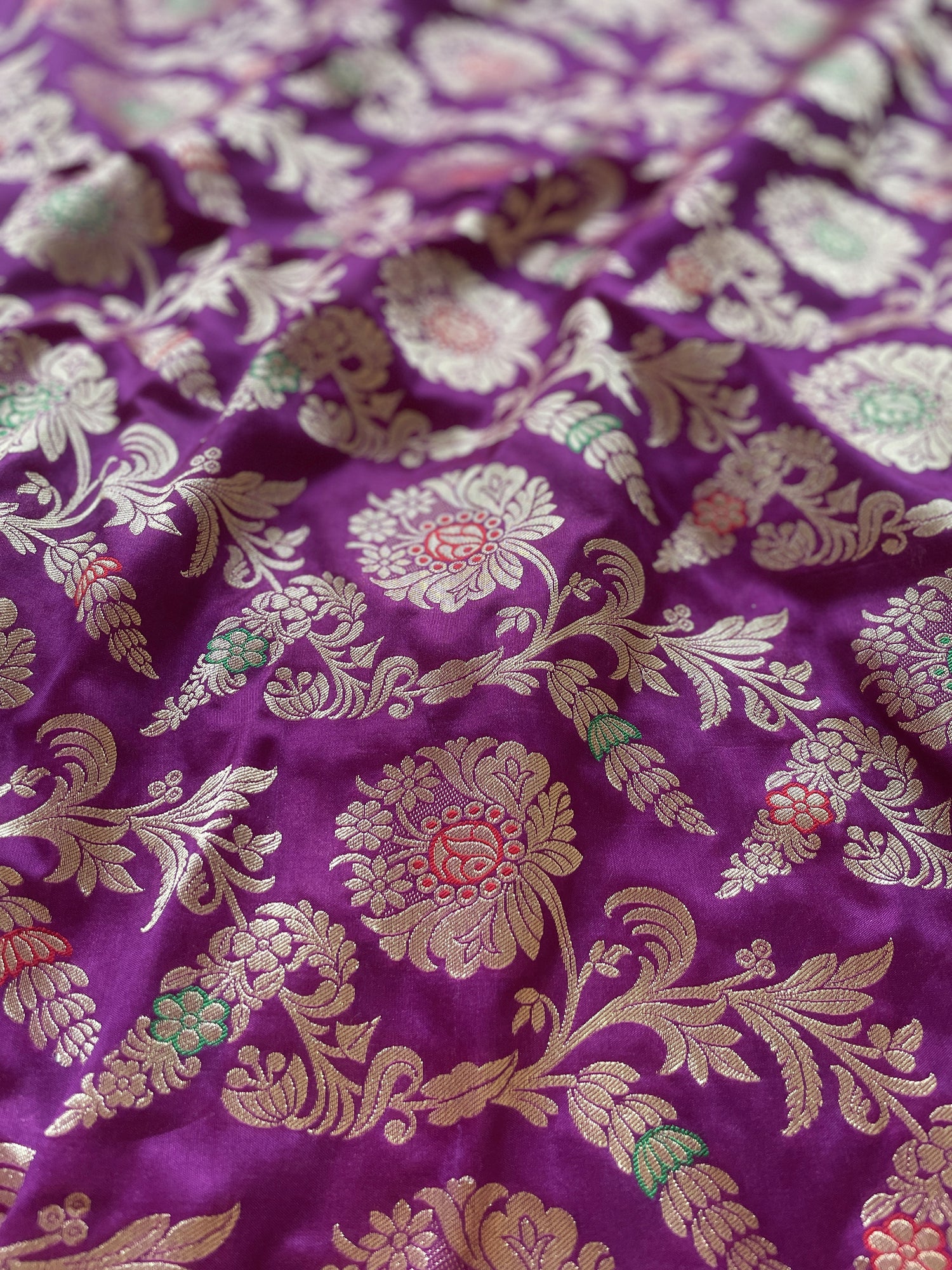


Quick Answer What Is the Difference Between Kadhua and Phekwa
Kadhua (also called Kadhwa or Kadwa) works separate motifs individually with supplementary weft. Phekwa (also called Fekwa) carries supplementary weft across the width; unused portions may form floats and can be clipped in finishing. Kadhua work often needs more individual motif labour and can cost more when materials and pattern complexity are otherwise comparable. Phekwa can also be an authentic Banarasi weave.
Kadhua vs Phekwa at a Glance
|
Factor |
Kadhua |
Phekwa |
|---|---|---|
|
How motifs are made |
Worked individually |
Supplementary weft carried across the width |
|
Reverse side |
Usually fewer long connecting floats between separate motifs |
May show floats or clipped threads |
|
Time and labour |
Generally more for comparable motif work |
Generally more efficient for comparable work |
|
Price |
Often higher, all else equal |
Often more accessible, all else equal |
|
Typical choice |
Intricate heirloom or bridal work |
Festive and wedding guest wear across budgets |
|
Guarantees pure silk or real zari |
No |
No |
The table describes a general construction difference. A dense Phekwa saree can cost more than a simple Kadhua one if its silk, zari and pattern are more expensive.
What Is Kadhua Weaving
In Kadhua weaving, an artisan works individual decorative motifs into the ground fabric instead of carrying a patterning thread across every space between them. Think of a field of small bootis: each can be created as a separate woven unit. The reverse around those motifs generally has fewer long, unused decorative floats.
Kadhua is a method of making the design, not a fabric name. You may see a Katan Kadhua or a Tissue Kadhua saree because the base and the decorative construction answer different questions. For a fabric comparison, read Tissue Silk vs Organza vs Katan Silk.
The Government of India’s documentation of Banaras brocades and sarees records traditional extra-weft work described as *kardhwan* and *fekwa*. These are textile construction terms rather than modern purity certifications.
Why Can Kadhua Cost More
Working motifs separately can take more attention and time, particularly with dense bootis, multicolour Meenakari, a Jangla pattern, elaborate borders or a complex pallu. Still, no fixed number of weaving days or universal price premium applies. Ask what makes the specific saree labour-intensive.
What Does the Reverse of Kadhua Look Like
Look behind several separated motifs. The back need not mirror the front, but individually worked motifs typically do not have long decorative threads travelling from one motif to the next. A close photo of both sides is more informative than a label that merely says “premium Kadhua.”
What Is Phekwa Weaving
In Phekwa, the decorative supplementary weft travels across the width as the pattern is formed. Between motifs it may float on the reverse; finishing can involve clipping unused lengths. This is why shoppers sometimes encounter Phekwa and cutwork in the same discussion. The India Handloom Brand product specifications separately list Banarasi cutwork among recognised handloom product types.
Is Phekwa a Fake or Machine Made Banarasi
No. The weaving method does not establish whether a saree was made on a handloom or a powerloom. Seeing clipped threads on the back is also insufficient on its own to establish origin. Ask the seller for the loom type, composition and provenance of the individual piece. For a wider checklist, see how to identify an original Banarasi saree.
Does Kadhua Mean Better Quality
It often signals more work in separated motifs, but quality depends on the whole saree. Compare silk or other fibre composition, zari description, motif definition, finishing, drape and consistency. A well-executed Phekwa saree may suit a buyer better than a roughly finished Kadhua one.
Pure silk is a separate question. The Silk Mark Organisation of India says its label provides assurance of 100% natural silk for products sold by authorised users; it does not certify zari purity or quality. Kadhua and Phekwa by themselves certify neither.
Does Kadhua Last Longer Than Phekwa
There is no reliable lifetime guarantee based on the technique alone. Fewer long floats between motifs can make a Kadhua reverse neater, but wear depends on the base textile, zari, handling and storage. Follow the care label and see Umay’s Banarasi silk saree care guide for general storage advice.
Why Are Kadhua and Phekwa Sarees Priced Differently
If two pieces use comparable silk, zari, pattern coverage and finishing, individually worked motifs can raise the labour cost of Kadhua. Real-world comparisons rarely hold all those factors constant. A higher price may also reflect the silk grade, zari composition, motif density, colours, border, pallu and retail costs.
When a seller explains a premium solely by saying “Kadhua,” ask which motifs are worked separately, how dense the work is, what the zari contains and whether a close reverse-side photograph is available. These questions reveal much more than an unsupported price rule.
Which Weave Is Better for a Bride or a Wedding Guest
|
Your priority |
Useful starting point |
What to verify |
|---|---|---|
|
Elaborate bridal or heirloom look |
Kadhua |
Motif workmanship, base fibre, zari and weight |
|
Traditional detail within a tighter budget |
Phekwa |
Finishing, reverse side and fibre composition |
|
Lighter wedding guest outfit |
Either |
Actual saree weight, border and drape |
|
Intricate Meenakari or Jangla |
Often Kadhua |
The exact product’s construction and motif detail |
Umay’s bridal Banarasi sarees include pieces described as Katan Kadhua and Meenakari. Its wider Banarasi collection lets shoppers compare designs before deciding how much detailed motif work they want to pay for.
Is Kadhua Always Heavier Than Phekwa
No. Weight depends on the base fabric, zari coverage, border, pallu, motif density and embellishment. A Kadhua saree with widely spaced motifs can feel lighter than one with dense continuous supplementary work. Ask for the product weight and a drape video when those details matter to you.
What Do Katan GI and Silk Mark Mean in This Comparison
Kadhua and Phekwa describe motif-weaving methods. Katan describes a silk yarn or fabric base. Zari is the decorative yarn, whose composition needs separate verification. Silk Mark relates to silk content on eligible labelled products, while the Banaras Brocades and Sarees GI relates to the registered geographical indication.
The official Geographical Indications Registry entry for Banaras Brocades and Sarees lists the indication as registered. A product description invoking “Banarasi” or “GI” is not, by itself, individual proof that the saree meets every provenance or material claim. Check the individual product details and any documentation supplied with it.
For more on the silk base, read Umay’s guide to identifying original Katan silk sarees or explore the Katan silk collection.
How to Check Kadhua vs Phekwa Before Buying
Ask the Seller About the Motifs
Ask whether the motifs are made separately or with a supplementary weft carried across the width. A knowledgeable seller should be able to show the distinction on the specific saree.
Inspect the Reverse
Look behind two or three well-separated bootis. Ask for a close photograph or a short video that shows the reverse slowly. Do not diagnose the entire saree from a single loose thread.
Check the Fibre and Zari Claims
Ask for exact fibre content, the type of zari and any relevant silk documentation. Silk Mark’s consumer FAQ is useful for understanding what its label does and does not assure.
Compare Like with Like
When comparing prices, hold the base fabric and design density as constant as possible. A sparse Kadhua on one silk base and a dense Phekwa on another are not a fair side-by-side price test.
Request a Drape Video
A video can reveal sheen, fall, border weight and how the pallu moves. It may also show the reverse construction more clearly than an edited product photograph.
Kadhua vs Phekwa Which One Should You Buy
Choose Kadhua if individually worked motifs and intricate decorative work are central to the saree you want, and you value the additional labour involved. Choose Phekwa if you prefer its design, drape or price and the seller can explain its materials and workmanship clearly. Both can be valid Banarasi purchases.
Start with Umay’s Banarasi sarees, or browse bridal Banarasi sarees for a ceremonial outfit. If fabric is still the main decision, compare Tissue, Organza and Katan first. Turn the saree over, compare the details, and buy the piece whose construction and feel justify its price to you.
Frequently Asked Questions
What is the difference between Kadhua and Phekwa Banarasi sarees?
Kadhua generally works decorative motifs individually. Phekwa carries the supplementary patterning weft across the width; unused lengths can form floats or be clipped. The techniques affect labour and the appearance of the reverse.
Are Kadhua Kadwa and Kadhwa the same?
These are common English spellings used for the Banarasi motif-weaving technique. Sellers and artisans may transliterate the term differently.
Are Phekwa and Fekwa the same?
Yes. They are spelling variations of the term used for continuous supplementary-weft construction in this context.
Is a Phekwa Banarasi saree fake?
No. Phekwa is a weaving technique. Confirm handloom status, materials and origin separately for the particular saree.
Why does Kadhua often cost more?
Individually worked motifs can require more labour than continuous supplementary-weft patterning when the other construction details are comparable. Silk, zari, design density and finishing also influence the price.
How can I identify a Kadhua saree?
Ask for a clear view of the reverse around separated motifs. It generally has fewer long decorative floats connecting those motifs. Confirm with the seller rather than relying on one visual clue.
Is every Kadhua saree pure silk?
No. Kadhua names the motif technique, not the fibre. Check the individual product’s composition and relevant documentation.
Which is better for brides Kadhua or Phekwa?
Kadhua is a useful starting point for detailed heirloom or bridal work; Phekwa can also be a good choice when the particular design and price fit the occasion. Compare the full saree, not just the technique.


