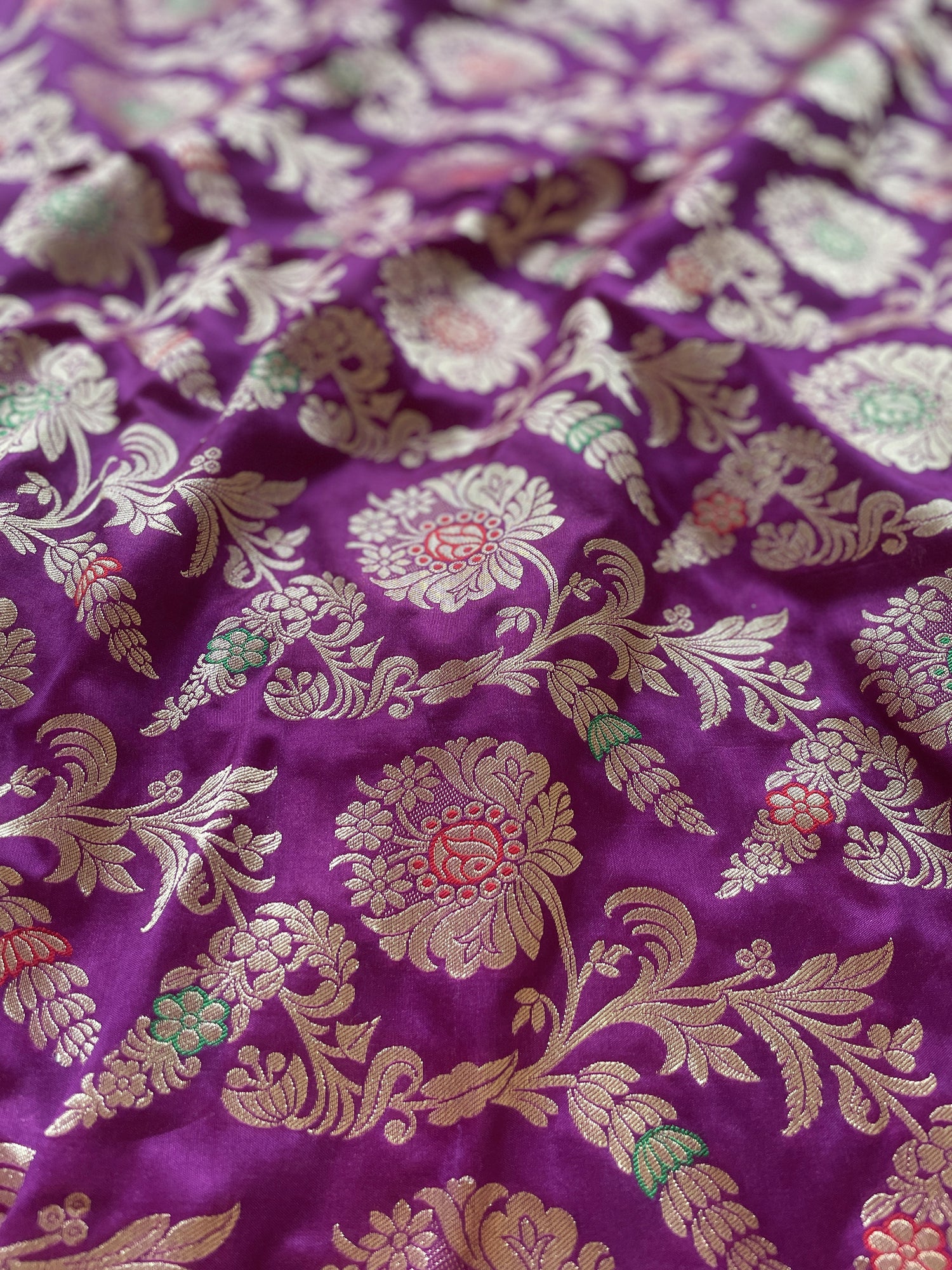


Choosing between Tissue Silk, Organza and Katan Silk sarees can be confusing.
All three can look luxurious. All three work beautifully for weddings and celebrations. And when you are shopping online, photographs can make them look surprisingly similar.
But wear them once and the difference becomes obvious.
Tissue Silk catches light with a metallic glow. Organza creates a crisp, airy silhouette. Katan Silk feels richer, smoother and more traditionally substantial.
So which one should you actually buy?
The answer depends less on which fabric is “best” and more on when you plan to wear it, how you like your saree to drape, the weather, the level of formality and whether you want something contemporary or heirloom-like.
This guide compares all three so that you can make that decision before investing in your next saree.
Tissue Silk vs Organza vs Katan Silk
Choose Tissue Silk when you want a lightweight saree with metallic sheen and festive impact.
Choose Organza when you prefer an airy, sheer and crisp saree, particularly for daytime or warm-weather occasions.
Choose Katan Silk when you want a richer pure-silk base with a smooth feel, traditional Banarasi character and strong heirloom potential.
There is no universal winner.
The right saree depends on what you expect from it.
Tissue Silk vs Organza vs Katan Silk at a Glance
|
Feature |
Tissue Silk |
Organza |
Katan Silk |
|
Overall Look |
Metallic and luminous |
Sheer and ethereal |
Rich and traditional |
|
Feel |
Light with gentle structure |
Crisp and airy |
Smooth and substantial |
|
Transparency |
Semi-sheer to translucent |
Usually highly sheer |
Mostly opaque |
|
Shine |
High metallic sheen |
Soft, glass-like sheen |
Natural silk lustre |
|
Drape |
Structured but relatively fluid |
Crisp and voluminous |
Smooth and graceful |
|
Best For |
Receptions, weddings, festive events |
Day weddings, summer events, parties |
Weddings, bridal wear, traditional occasions |
|
Visual Style |
Contemporary luxury |
Minimal and modern |
Timeless luxury |
|
Heirloom Appeal |
High when well made |
Moderate |
Very high |
|
Care |
Delicate |
Delicate and snag-prone |
Requires silk care |
|
Ideal Buyer |
Wants shine without excessive heaviness |
Wants airy sophistication |
Wants traditional silk richness |
What Is a Tissue Silk Saree?
A Tissue Silk saree is known primarily for its metallic-looking surface and luminous appearance.
In Banarasi tissue weaving, fine silk yarns may be combined with zari to create the characteristic sheen. The interaction between silk and metallic yarn produces a fabric that changes subtly as light falls across it.
That is why a tissue saree often looks different in daylight, indoor lighting and photographs.
Umay Benaras' current Tissue Silk collection describes these sarees as using fine silk threads with zari to create their signature soft shine and lightweight festive character.
The result is a saree that can appear luxurious without needing heavy embroidery.
How Does Tissue Silk Feel?
Good Tissue Silk should have some structure, but it should not feel like a rigid sheet.
Depending on the yarns, weave and zari, the saree can range from relatively fluid to distinctly crisp.
It usually sits between Organza and traditional Katan in terms of visual weight:
more luminous than Katan, but generally less airy than Organza.
What Makes Tissue Silk Special?
Its biggest advantage is its ability to create drama through the fabric itself.
A plain gold, champagne, rose-gold or silver-toned Tissue Saree can make a statement without complicated surface decoration.
That makes it particularly useful when you want the saree to look festive but not overloaded.
What Is an Organza Saree?
Organza is a lightweight, sheer and crisp plain-woven fabric.
Traditional Organza was produced from silk, although modern Organza may also be made from synthetic fibres such as polyester or nylon. That means you should never assume that every saree described simply as “Organza” is automatically pure silk.
This matters considerably when comparing prices.
A pure silk Organza saree and a synthetic Organza saree may look similar in edited photographs while differing significantly in fibre composition, feel and value.
How Does Organza Feel?
Organza is generally crisp rather than soft and flowing.
It tends to hold itself away from the body, producing a slightly sculptural silhouette.
That property is exactly why Organza is popular for:
day weddings, summer functions, floral sarees, contemporary festive dressing and minimalist occasion wear.
It can feel almost weightless, but its structure gives the saree visual volume.
What Makes Organza Special?
Organza is about lightness and space.
Tissue catches the light.
Katan showcases silk richness.
Organza creates air around the silhouette.
That is why embroidered florals, delicate prints and small motifs often work beautifully on Organza without making the saree feel visually heavy.
What Is a Katan Silk Saree?
Katan is deeply associated with traditional Banarasi weaving.
According to the Government of India's India Handloom Brand specification for Banaras Brocade Sarees, two-fold twisted mulberry silk yarn is locally known as Katan and is used in the ground warp and weft of traditional Banaras brocade, along with zari for decoration.
That twisted silk construction creates a strong, smooth base capable of supporting detailed weaving.
This is one reason Katan has remained important in premium Banarasi sarees.
How Does Katan Feel?
Katan generally has:
a smooth surface, natural silk lustre, more substance than Organza, and a graceful yet controlled drape.
Unlike Tissue, its visual identity does not depend mainly on metallic shine.
Unlike Organza, it is not defined by transparency.
Instead, Katan gets much of its appeal from the quality of the silk and the weave placed over it.
Umay Benaras currently carries Katan Banarasi sarees ranging from relatively minimal designs to elaborate Kadhua, Meenakari, Jangla, Tanchoi and zari compositions.
Tissue Silk vs Organza: What Is the Main Difference?
This is probably the comparison shoppers make most often.
Both fabrics can look lightweight and luminous.
But the effect is very different.
Tissue Silk Gives You Shine
The first thing you notice about Tissue is usually its glow.
Metallic yarns can create shades of:
gold, silver, copper, rose gold and champagne.
That makes Tissue particularly attractive for evening weddings and receptions where artificial light brings the surface alive.
Organza Gives You Transparency
The defining feature of Organza is not metallic shine but sheerness and crispness.
The fabric is thin and airy, allowing the blouse and underlying layers to become part of the final visual effect.
If Tissue says:
“Look at the fabric.”
Organza often says:
“Look at the silhouette.”
Tissue Silk vs Katan Silk: Which Looks More Luxurious?
Both can look luxurious, but they communicate luxury differently.
A Tissue Silk Saree has a lighter, shimmering form of luxury.
A Katan Silk Saree has a deeper, more traditional form of luxury.
Imagine two wedding looks.
One uses a champagne Tissue saree with minimal jewellery and a contemporary blouse.
The other uses a deep crimson Katan Kadhua Banarasi with traditional zari and heirloom jewellery.
Neither is less luxurious.
They simply speak different design languages.
Choose Tissue When You Want:
Modern glamour, metallic colour, lighter visual weight and contemporary wedding styling.
Choose Katan When You Want:
Traditional Banarasi richness, strong silk character, detailed weaving and an heirloom aesthetic.
Organza vs Katan Silk: Which Is Better for Weddings?
This comparison depends heavily on the type of wedding event.
For a daytime summer wedding, Organza can make considerable sense.
For the main wedding ceremony or a traditional bridal look, many buyers may prefer Katan.
Here is why.
Organza gives you:
lightness, crispness, transparency and understated visual impact.
Katan gives you:
rich silk, traditional structure, stronger opacity and the capacity to carry elaborate Banarasi weaving.
The Government of Uttar Pradesh's Varanasi resource describes Banaras brocade sarees as finely woven silk decorated with intricate zari and notes traditional characteristics such as floral motifs, metallic effects, jali patterns and meena work.
Katan provides an especially strong foundation for this kind of textile work.
Which Saree Is Best for a Wedding?
There is no need to make one fabric handle every event.
A wedding wardrobe becomes easier when each saree has a purpose.
|
Wedding Event |
Good Fabric Choice |
Why |
|
Haldi |
Organza |
Light, fresh and easy visual styling |
|
Mehendi |
Organza or light Tissue |
Contemporary and festive without looking too formal |
|
Engagement |
Tissue Silk |
Elegant shine with manageable visual weight |
|
Sangeet |
Tissue Silk |
Metallic surface responds beautifully to evening lighting |
|
Wedding Ceremony |
Katan Silk |
Traditional richness and stronger heirloom character |
|
Reception |
Tissue Silk or Katan |
Choose Tissue for glamour, Katan for classic grandeur |
|
Post-Wedding Puja |
Katan |
Traditional and timeless |
|
Daytime Festive Event |
Organza |
Crisp and understated |
This is a guideline, not a rule.
Personal style should always come first.
Which One Is More Comfortable: Tissue, Organza or Katan?
Comfort cannot be judged from the fabric name alone.
The yarn composition, zari, border, embroidery, width, blouse and even draping style affect how a saree feels.
Still, broadly:
Organza usually feels the lightest and airiest.
Tissue can remain lightweight while offering slightly more body and festive presence.
Katan usually feels more substantial, although high-quality silk itself has excellent draping properties.
The Silk Mark Organisation of India describes silk as naturally light, lustrous, moisture absorbent and highly drapeable.
So do not automatically assume that a traditional silk saree must feel uncomfortable simply because it has more substance.
Which Saree Works Best in Hot Weather?
For very warm outdoor functions, Organza often has an advantage because of its open, airy character.
But fibre composition matters.
A silk Organza and polyester Organza will not necessarily behave identically.
Similarly, a lightweight pure-silk Tissue may feel very different from a heavily zari-dense Tissue saree.
When shopping online, ask:
What fibre is used?
How heavy is the zari?
How transparent is the fabric?
Is the saree intended to be crisp or soft?
Those questions are more useful than simply asking:
“Is this a summer saree?”
Which Saree Photographs Better?
All three can photograph beautifully.
They just react differently to light.
Tissue Silk
Creates highlights and reflections, especially under warm evening lighting.
It is particularly effective for receptions, cocktail events and indoor wedding photographs.
Organza
Creates softer visual layers.
The sheer fabric works well in daylight, outdoor shoots and pastel styling.
Katan
Creates rich colour saturation and visible woven detail.
It works particularly well in close-up bridal photographs where zari, borders and motifs need to remain visually important.
The better question is therefore not:
Which fabric photographs better?
It is:
What kind of photographs do you want?
Which Saree Looks More Traditional?
Katan usually has the strongest association with classic Banarasi silk dressing.
That does not mean Tissue is modern or Organza cannot be traditional.
Banarasi weaving has long used different materials, structures and techniques.
What changes is the visual mood.
Katan communicates:
heritage and richness.
Tissue communicates:
ceremonial shimmer.
Organza communicates:
lightness and refinement.
Which Fabric Is Better for an Heirloom Saree?
For a saree you hope to keep for decades or eventually pass down, Katan Silk is a particularly strong choice.
Its association with pure silk, robust yarn structure and elaborate Banarasi weaving gives it natural heirloom appeal.
High-quality Tissue can also make a beautiful heirloom, particularly when made with pure silk and quality zari.
Organza can be preserved too, but its delicate sheer construction means it requires careful handling.
The Silk Mark Organisation says that properly cared-for silk sarees can last for generations.
That makes the actual fibre composition important.
How Can You Check Whether the Saree Is Pure Silk?
Do not rely on the words:
“premium,” “pure,” “luxury” or “Banarasi-style.”
Ask what the saree is made from.
The Silk Mark Organisation of India states that Silk Mark labels are affixed only to 100% pure silk products by authorised users.
It also makes an important clarification:
Silk Mark verifies silk purity. It does not certify the purity or quality of zari.
This matters particularly when comparing premium Tissue and Banarasi Katan sarees because zari can represent an important part of their appearance and value.
Tissue Silk, Organza or Katan: Which One Should You Buy?
Use your wardrobe rather than trends to make the decision.
|
If You Want… |
Choose |
|
Metallic shimmer |
Tissue Silk |
|
A very light visual appearance |
Organza |
|
Traditional Banarasi richness |
Katan |
|
An evening reception saree |
Tissue |
|
A daytime summer saree |
Organza |
|
A bridal heirloom |
Katan |
|
Contemporary minimal styling |
Organza |
|
Modern festive glamour |
Tissue |
|
Intricate classic Banarasi weaving |
Katan |
|
A saree that stands out under lights |
Tissue |
|
An airy, almost floating silhouette |
Organza |
|
A saree to preserve for generations |
Katan or high-quality pure Tissue |
What Should You Check Before Buying Any of the Three Online?
Online photographs can hide the qualities that separate one fabric from another.
Before purchasing, check the exact fibre composition, weave, zari description, transparency, blouse piece, care instructions and close-up photographs.
For higher-value sarees, video assistance can be especially useful because movement reveals characteristics that still photographs cannot.
You can see:
how the pallu falls, how strongly the fabric reflects light, how crisp the pleats are, and how transparent the weave is.
These small details can prevent the common mistake of buying a saree that photographs perfectly but feels completely different from what you expected.
Explore Tissue and Katan Sarees at Umay Benaras
If your preference is light-filled festive glamour, explore Umay Benaras' current Tissue Silk collection, which includes Banarasi Tissue designs across different colours and weaving treatments.
Explore Banarasi Tissue Silk Sarees
If you prefer traditional silk richness and a more heirloom-oriented drape, explore the Katan Silk collection.
Explore Banarasi Katan Silk Sarees
For shoppers still deciding between different Banarasi fabrics and weaving styles:
Final Verdict
The difference between Tissue Silk, Organza and Katan Silk sarees is not simply about which one costs more or looks more luxurious.
Each fabric creates a different experience.
Choose Tissue Silk when you want light, reflection and contemporary festive glamour.
Choose Organza when you want an airy, crisp and understated silhouette.
Choose Katan Silk when you want smooth pure-silk richness, traditional Banarasi character and an heirloom-quality aesthetic.
And if you are still undecided, start with the occasion.
A fabric becomes much easier to choose once you know where you will wear it, how long you will wear it and how you want to feel in it.
The best saree is not simply the most expensive one.
It is the one whose fabric works with you rather than against you.
Frequently Asked Questions
1. What is the main difference between Tissue Silk, Organza and Katan Silk?
Tissue Silk is primarily known for metallic sheen and a light structured drape. Organza is sheer, crisp and airy. Katan uses twisted silk yarn and produces a smoother, richer base traditionally associated with premium Banarasi sarees.
2. Which is better: Tissue Silk or Organza?
Choose Tissue Silk if you want more shine and festive impact. Choose Organza if you prefer transparency, crispness and an airy silhouette. Tissue usually suits evening celebrations particularly well, while Organza is popular for daytime and warm-weather functions.
3. Which is better: Tissue Silk or Katan Silk?
Neither is universally better. Tissue creates a lighter and more luminous look, while Katan offers a richer traditional silk appearance. For a contemporary reception look, Tissue may work well. For a classic wedding or heirloom saree, Katan is often a strong choice.
4. Is Katan Silk pure silk?
Traditional Katan refers to twisted mulberry silk yarn. The India Handloom Brand specification for Banaras Brocade identifies two-fold twisted mulberry silk yarn as locally called Katan. When purchasing, however, verify the fibre composition of the individual saree rather than relying only on its product name.
5. Is Organza always made from silk?
No. Traditional Organza was made from silk, but modern Organza can also be produced from synthetic fibres such as polyester and nylon. Check the fibre composition before comparing quality or price.
6. Which saree is best for a summer wedding?
Organza can be a good option because of its lightweight, sheer construction. A lightweight Tissue saree may also work well. Always consider the actual fibre, amount of zari, venue and length of the function rather than choosing only by fabric name.
7. Which saree is best for a bride?
Katan Silk works particularly well for traditional bridal styling and heirloom Banarasi sarees. Tissue Silk is an excellent option for engagements and receptions where metallic shine is desired. The best choice ultimately depends on the wedding style and personal preference.
8. Which saree lasts the longest?
High-quality silk sarees can last for generations when stored and cared for correctly. Katan is particularly attractive for heirloom use because of its silk yarn structure, while premium pure-silk Tissue can also be preserved for many years. Delicate Organza requires more careful handling.


